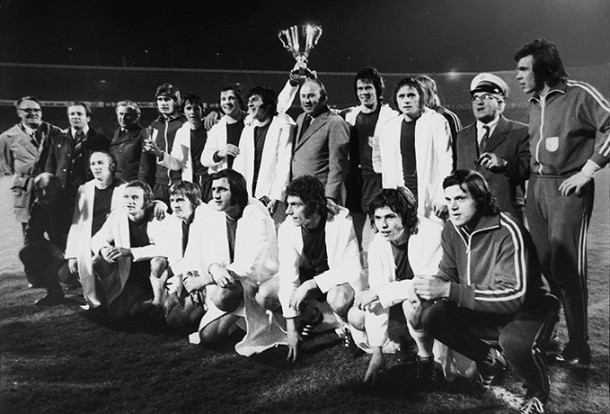
Coming 33 years after the first, the Wembley meeting of Bayern Munich and Borussia Dortmund in this season’s Champions League will be just the second all-German European club Final. Eintracht Frankfurt and Borussia Mönchengladbach contested that first one – the 1980 UEFA Cup Final – and the involvement of two Bundesliga sides at the sharp end told a story about the distinctive nature of that tournament. Two teams from one country reaching the Final was itself not especially unusual – England and Spain had provided both finalists in past UEFA and Fairs Cup Finals – but what stood out was the dominance by clubs from a single country to an extent not seen in any European tournament before or since.
While the West German champions of the late 70s couldn’t quite match the English in the European Cup, the sheer strength in depth of the Bundesliga did lend itself to a virtual monopoly over the UEFA Cup. Three of the four semi-final places in the 1978/79 tournament were taken by German clubs with Borussia Mönchengladbach going on to win it for the second time in just four seasons. The German stranglehold on the competition would grow tighter still in the 1979/80 tournament. The holders progressed comfortably to the Quarter-Finals as did all four of the other Bundesliga entrants – Bayern Munich, Eintracht Frankfurt, Kaiserslautern and Stuttgart. It was an unprecedented feat to have five participants from one country in the last-eight of the UEFA Cup, especially as no nation had even fielded five entrants in the competition before – West Germany were given a fifth place only because Albania did not take up its allocation.
In the broader scheme of things, a barrage of rotten fruit and vegetables is not the worst welcome a national squad can face upon return from a disastrous World Cup tournament. The 1966 Italian squad famously suffered this indignity at Genoa airport, an angry crowd throwing ripe insults and overripe produce at their lazy, greedy and vainglorious players. No-one would have thought to label the group as unpatriotic or ideologically unsound though, and certainly no-one would have started an insidious persecution campaign against them as a punishment. After a disappointing tournament of their own four years later in Mexico, this was the sinister welcome Bulgaria’s players and coaching staff faced on their return to Sofia.
After winning an Olympic silver medal two years earlier in Mexico City, the Bulgarian Communist Party (BCP) had high hopes for the national team’s World Cup prospects in Mexico ’70. Olympic football was a sham though, dominated by eastern European nations through their generous interpretation of amateurism, and as a tournament it was no guide to World Cup form at all.
BTLM was thrilled to learn that Helenio Herrera released a record called the ’Herrera cha-cha-chá‘ in his early managerial days in Italy. Tactician, icon, legend and now song and dance man too – was there no end to the great man’s talents? This one is a conceptually tricky idea to grasp though: Herrera’s stern, authoritarian demeanour didn’t readily suggest he could easily slip into loose-limbed crooner mode when he wanted a break from the daily grind of winning European Cups and bellowing mantras about sound defending loudly in the faces of his players.
A little while ago we took an affectionate look back
Eric’s first ever World XI was a real veterans team featuring seven players over the age of 30 and an average age higher than any future World XI. There was no argument with the selection of Puskas and Di Stefano in this, or a number of subsequent years, however some players like Hungarian keeper, Grosics, and full-backs, Bergmark and Nilton Santos, were past their best and their nomination perhaps reflected more their outstanding contributions to the game, rather than necessarily recent form.
With the World Cup 2014 qualifying campaign well underway, Belgium is attracting a lot of attention thanks to the emergence of a new generation of highly promising and expensively traded young players. The Belgians have had a second-rate national team since the mid-1990s, but with talent of the calibre of Eden Hazard, Axel Witsel, Vincent Kompany, Thomas Vermaelen, Moussa Dembélé and Romelu Lukaku available nowadays to trainer George Leekens, supporters can now realistically dream of a return to the nation’s successful 70s and 80s heyday.
After the war, Kreitlein returned to work in Stuttgart as a tailor and played part-time with his local club until a knee injury ended his career in 1951. Determined to stay in the game in some capacity, he turned once again to refereeing. It was very much a part-time hobby for him, yet by the time of the inception of the Bundesliga in 1963, his reputation was strong enough to gain a nomination as a national referee.
The latest post in our ongoing Shorts series collects up some quirky bits and pieces from 60s and 70s Soviet football. Пойдем!!!!
Zenit St.Petersburg can claim Russian Premier Vladimir Putin among its supporters and it’s a club that in its various guises has always been well-connected politically. During its Zenit Leningrad incarnation, the club finished plum bottom of the Soviet Top League in 1967 yet still managed to retain top flight status. There was no precedent of similar benevolence being shown to other clubs in that position. The Soviet Federation rather spuriously explained why Zenit were a special case and deserved to stay among the Soviet elite. It was all about the city apparently. The February 1917 Revolution had recently celebrated its 50th anniversary and as Leningrad (or Petrograd as it was known at the time) had been the focus of the uprising, so it deserved a special status that was conveniently extended to its sporting institutions.
Diving and feigning injury remains a thorny issue in the contemporary game and those who retain a sense of righteous indignation about such shenanigans would probably loudly cheers the reaction of a particular Soviet journalist to such an event. When Celtic played Dynamo Kiev in the 1967/68 European Cup, Kiev’s Josif Sabo went down softly under a tackle from Bobby Murdoch and the Scot was sent off for protesting the decision going against him. Soviet sports writer, Yuri Vanyat, was so affronted by Sabo’s underhand tactics that he wrote a public letter to the Central Council of Sports Societies asking them to remove the player’s title of ‘Merited Master of Sport’.
It wasn’t quite as simple and glorious a time as it appeared though. ”Nem tudo que reluz é ouro” is the Portuguese version of the English saying “All that glitters is not gold” and the surface glitter of trophy success and world-class players resplendent in the famous red jersey masked what was, in reality, the most deeply shocking season in the club’s history. Benfica would be hit first by a dreadful human tragedy involving one of their players in December 1966. “Uma desgraça nunca vem só” is another common Portuguese saying, translating as “a misfortune never comes alone.” Horrifically this was all too prophetic; only a matter of a couple of months later, and just as some sort of equilibrium was returning to the club, a second player tragedy would strike. This is the first of a two-part story looking back at those couple of fateful months.