
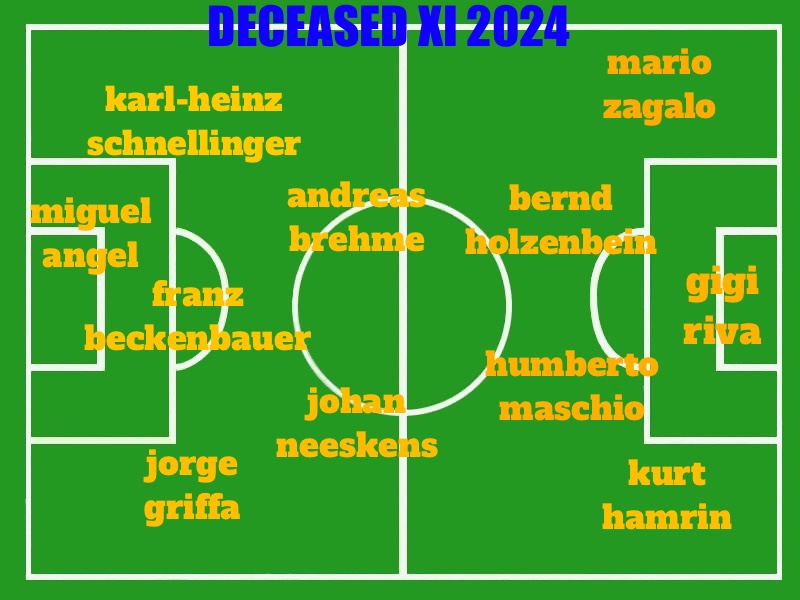
We round off another year on Beyond The Last Man with our annual tribute to, and recognition of, the great footballers we have lost over the past 12 months. If you are new to our Deceased Eleven feature, each year end we assemble an imagined team featuring the very best of these footballers.
Our selections always seek to conform to best practice and aim for defensive and attacking balance, with players selected to play in – or close to – the positions for they were recognised during their illustrious careers. Sometimes we will improvise and imagine a player in a slightly different role for which we believe he could easily have adapted if needed during his career.
When preparing this selection we have a cut off date of the third week of December, so there is a small window right at the end of the year not covered. We will include any appropriate players in our next year’s team accordingly, so don’t write in.
Each year throws up a unique challenge to find a suitable formation for the players we have selected and this year we have picked a 3-4-3, 0r 3-2-2-3 line-up to best accommodate their qualities. Over the course of their collective careers our Eleven won a total of 536 international caps and scored 206 international goals.

CENTRE HALF – JORGE GRIFFA (Argentina) – Born 1935. 4 caps (1959)
When Griffa moved to Spain and Atlético Madrid in 1959, so began a long and fruitful relationship between the aggressive but resourceful defender and the Spanish game. The Argentine would be a mainstay in Madrid for the next decade where his tenacious style and great leadership quality brought trophy success and granted him club legend status.
SWEEPER – FRANZ BECKENBAUER (West Germany) – Born 1945. 103 caps / 14 goals (1965-77)
‘Der Kaiser’ was a pioneering footballer rather than just a brilliant one. Sometimes a defender, sometimes a midfielder, Beckenbauer was known primarily as one of the first great sweepers, a role he revolutionised with his great intelligence and understanding of the tactical set-up of the game around him.
He was indispensable brains behind the great Bayern Munich side which won a trio of European Cups in the mid-70s and captained his country to both European Championship and World Cup success.
CENTRE HALF – KARL-HEINZ SCHNELLINGER (West Germany) – Born 1939. 47 caps / 1 goal (1958-71)
Powerful, quick and determined, Schnellinger made his name as one of the best attacking left-backs in the world and then converted to become one of the best sweepers too. A West German title winner with Köln then a Serie A and European Cup winner with Milan whom he served with distinction for a decade.
This fine defender was a key member of the West German national side and represented them at four successive World Cups between 1958 and 1970.
DEFENSIVE MIDFIELD – ANDREAS BREHME (West Germany) – Born 1960. 86 caps / 8 goals (1984-94)
A generational great in his typical left-back role, Brehme was so much more than just a single-position full back. Strong defensively but capable of pushing up and playmaking from wide attacking positions, the much-lauded international benefited from being one of the most capable two-footed players in football history.
A domestic champion with Bayern Munich, Inter and Kaiserslautern, Brehme was a mainstay of the West German national team for a decade and scored the winner in the 1990 World Cup Final. In this team we have selected him in a defensive left-sided midfield role.
DEFENSIVE MIDFIELD – JOHAN NEESKENS (Netherlands) – Born 1951. 49 caps / 17 goals (1970-81)
If Johan Cruyff was the figurehead of Dutch football brilliance during the 1970s, Johan Neeskens was his incredibly able deputy. A physical, aggressive and tough-tackling midfielder, Neeskens could mix the defensive side of the game with a great capacity for incisive passing and powerful runs to support his attack.
ATTACKING MIDFIELD – BERND HÖLZENBEIN (West Germany) – Born 1946. 40 caps / 5 goals (1973-78)
An adaptable attacking player who was effective playing as a winger, centre-forward or attacking midfielder – where we have selected him. Hölzenbein represented Eintracht Frankfurt for a decade and a half and remains their highest-ever scorer with 160 goals, his importance for them replicated with the national team for whom he played in the World Cup Final of 1974 and the European Championship Final of 1976.
CENTRAL MIDFIELD – HUMBERTO MASCHIO (Argentina / Italy) – Born 1933. 16 caps / 12 goals (1956-62)
An adept finisher who found himself selected in attack because of his sharp eye for goal in his early playing days with Quilmes and Racing Club, Maschio moved to Italy and spent nine years with four different Serie A clubs. It was at Atalanta where he was shifted deeper into a more creative playmaker role, one he grew to relish with his strategic intelligence, high technical quality and awareness of space.
Maschio enjoyed a late career renaissance back in Argentina with Racing Club where his experience helped the club to League, Libertadores and Intercontinental Cup success.
LEFT WING – MARIO ZAGALO (Brazil) – Born 1931. 33 caps / 5 goals (1958-64)
What Zagalo lacked in devastating individual flair compared to some of his great Brazilian contemporaries in the 1950s and 60s, he more than made up for with his intelligence, understanding of balance and willingness to track back and defend to allow teammates like Pelé and Garrincha more free reign.
A fixture for Botafogo and his national side, Zagalo was one of Brazil’s key players in their 1958 and 1962 World Cup wins.
CENTRE FORWARD – GIGI RIVA (Italy) – Born 1944. 42 caps / 35 goals (1965-74)
Italy’s most prolific international striker and a legend in Cagliari where his goals inspired the club to a famous Serie A title win in 1970. Powerful, technically strong and boasting a ferociously explosive left-footed shot, Riva was a player renown for performing at his best on the biggest of occasions.
RIGHT WING – KURT HAMRIN (Sweden) – Born 1934. 32 caps / 17 goals (1953-65)
This quick and elegant winger was part of the famous Swedish front line which finished as runners-up in the 1958 World Cup to Brazil. Hamrin was already established in Serie A by this time and would represent five Italian clubs over a decade and a half there, most notably Fiorentina for whom he remains their highest-ever scorer with 208 career goals.

 Beyond The Last Man
As ever, quite a few greats have passed this year. Brehme particularly gone too soon. Looking back at Schnellinger’s career a few years ago I had forgotten he had played for Mantova and Roma directly after leaving Germany. I had assumed he’d gone straight to Inter.