
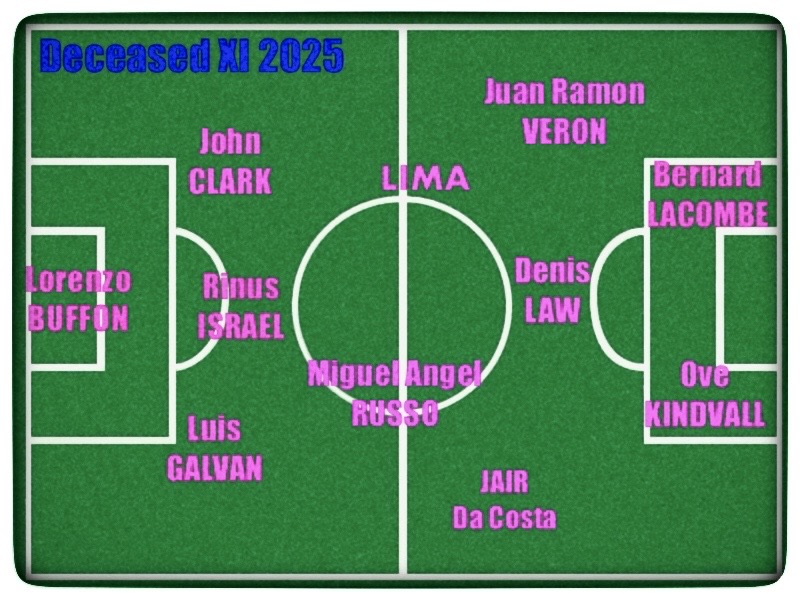
This final post of 2025 is our annual tribute to the footballers we have lost over the past 12 months. If you are new to our Deceased Eleven feature, each year end I assemble an imagined team featuring the very best of these footballers and attempt to justify their selections. Any player who passes away after the middle of December when I prepare this piece might miss consideration, but would qualify for the following year’s list.
I’m always at pains to emphasise that my selections are never a lop-sided mix of attack-orientated players shoe-horned in because they were more famous than comparable defensive players. That said, this year’s team is more orientated towards attacking players in midfield than many in the past and would turn out in a 3-2-3-2 formation. Over the course of their collective careers our 2025 Eleven won a total of 273 international caps and scored 66 international goals.
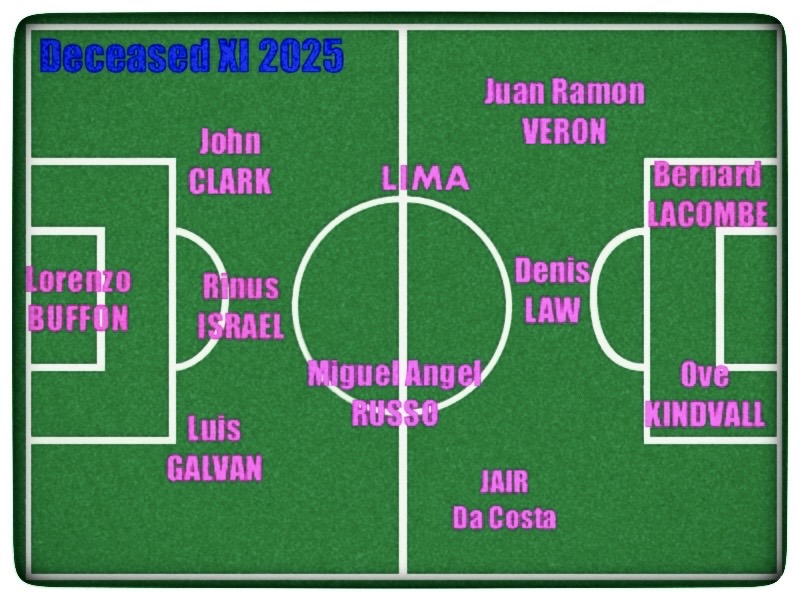
GOALKEEPER – Lorenzo Buffon (Italy, born 1929) (15 caps 1958-62)
One of the great Italian keepers, Buffon was an athletic shot-stopper who diligently performed his duties with the minimum of fuss. Buffon won five Serie A titles with Milan and Inter in the 1950s and 60s and was Italy’s starting keeper at the 1962 World Cup.
CENTRAL DEFENDER RIGHT- Luis Galván (Argentina, born 1948) (34 caps 1975-83)
Playing most of his career for unfashionable Talleres of Cordoba, Galván’s typically dogged and ultra-competitive style in defence helped shape them into a strong team that challenged regularly for League titles, without ever quite getting over the line. Best known as the central defensive partner for Daniel Passarella in Argentina’s successful 1978 World Cup campaign, the player was still a national team regular by the time the next World Cup came around.
CENTRAL DEFENDER – Rinus Israël (Netherlands, born 1942) (47 caps / 3 goals 1964-74)
A towering defender and a ferocious competitor, ‘Iron’ Rinus was the rock of the great Feyenoord teams of the late 1960s and early 70s that vied with Ajax for domestic and international dominance. A winner of four Dutch titles (one with DWS Amsterdam) and both the European and UEFA Cups in Rotterdam, Israël was an international regular for a decade culminating with the run to the 1974 World Cup Final.
CENTRAL DEFENDER LEFT – John Clark (Scotland, born 1941) (4 caps 1966-67)
One of the less famous players from Celtic’s great Lisbon Lions team, Clark was however a fine sweeper and a great foil for his central defensive partner Billy McNeill. A mainstay at the club throughout the 1960s, Clark’s career really took off with the arrival of Jock Stein and he became an untouchable regular throughout the club’s hugely successful era.
DEFENSIVE MIDFIELD – Lima (Brazil, born 1942) (14 caps, 4 goals 1963-66)
From the generation of outstanding young talent that Santos seemed to produce or acquire with nonchalant ease during the 1960s, Lima was another star who shone brightly in the Libertadores winning teams of 1962 and 1963. Athletic and adaptable, he started out in defence before moving to his natural midfield position in 1965. A regular for his country in these years, he played in all three of Brazil’s group games at the 1966 World Cup.
DEFENSIVE MIDFIELD – Miguel Ángel Russo (Argentina, born 1956) (17 caps, 1 goal 1983-85)
Playing his entire club career with Estudiantes meant Russo was not a well-recognised name abroad, but he was a talented deep-lying midfielder and a key contributor for his club from the mid 70s through to the end of the 80s. He would have featured in Argentina’s 1986 World Cup winning squad had injuries not ruled him out.
LEFT MIDFIELD / WINGER – Juan Ramón Verón (Argentina, born 1944) (4 caps 1968-71)
The infamous Estudiantes de La Plata side of the late 1960s that won three Libertadores titles and an Intercontinental Cup was a ferocious outfit, but the technically gifted creator and goalscorer Verón was the player who won games for them. A clever winger who roamed all over the front line and was renown for coming up with big goals in big games. The deplorable reputation of his teammates tarred Verón by association and he was never given much opportunity in a national jersey.
RIGHT MIDFIELD / WINGER – Jair da Costa (Brazil, born 1940) (1 cap)
Being unable to displace Garrincha on Brazil’s right wing did little to hamper the career of Jair who moved to Italy and Helenio Herrera’s Inter after the 1962 World Cup. At Inter his pace, skill and hard running, along with a European style defensive discipline, brought him four Serie A titles and two European Cup wins during his decade-long career there.
DEEP LYING FORWARD – Denis Law (Scotland, born 1940( (55 caps, 30 goals 1958-74)
The Scottish international team’s joint-highest scorer and one of the greatest players ever produced there, Law was a clever and technical striker very unlike the traditional forwards being produced in Britain in the 50s and 60s. Very adept at dropping into deeper positions to get the ball, he proved an elusive figure for defenders who could not neutralise his clever movement, running and unerring finishing.
The highlight of his career was winning a 1968 European Cup medal, though sadly he missed the final because of the troublesome knee issue which blighted much of his later career.
CENTRE FORWARD – Bernard Lacombe (France, born 1952) (38 caps, 12 goals 1973-84)
Ligue 1’s second-highest Ligue 1 top scorer with 255 goals, Lacombe was the epitome of the penalty box predator always capable of finding a yard of space for himself to score. Prolific in his earlier years with Lyon, he peaked later in his career with Bordeaux winning three titles there in the mid-1980s. His best scoring season came in 1984-85 when he scored 25 goals at the age of 32.
Influential for the national team too, he played at the 1978 and 1982 World Cups and won the European Championships in 1984.
CENTRE FORWARD – Ove Kindvall (Sweden, born 1943) (43 caps, 16 goals 1965-74)
Just five seasons of this fast, strong and technically proficient striker’s career were spent outside his native Sweden, but in that half-decade at Feyenoord he became one of the most feared strikers on the continent. Kindvall became the first foreign player to top the League’s scorers chart, a feat he repeated a further twice.
In total he scored 129 league goals in 144 games for the Rotterdam giants and played a big part in their considerable success in the late 1960s and early 1970s – including the decisive second goal that defeated Celtic in the 1970 European Cup Final.

 Beyond The Last Man